

Products and Platforms

The full AI voice stack, delivered in the form your product needs

mpWAV provides the complete voice interface stack — single- and multi-microphone enhancement, wake-word detection, sound source localization, multi-party processing, speaker diarization, on-device speech recognition, and a conversational LLM.

Depending on your microphone configuration, compute platform, development stage, and production plan, it can be applied as software/SDK, a microphone array module, DSP·FPGA·AP porting, technology licensing, or semiconductor IP·SoC collaboration.

Delivery options

Software·SDK · Edge AI · Mic-Array Module · Embedded Porting · License · SoC Partnership

Image [P1]
Products & platforms hero — technology stack → delivery forms → customer product

mpWAV Technology Stack (10 technologies)

↓ Software/SDK · Edge AI · Mic-Array Module · DSP·FPGA·AP Porting · License · SoC

↓ Customer Product — Earbuds · Robot · Kiosk · Vehicle · Meeting · Smart Device · Factory

From Technology to Implementation

What do we mean by products and platforms?

mpWAV's products and platforms are the software, AI models, hardware modules, and embedded implementations that package our voice algorithms for your product.

The same technology can be validated early with a PC-based SDK or PoC, while productization may require DSP·FPGA·AP porting, a microphone array module, or a semiconductor IP structure.

We don't just hand over technology — we shape it into something that runs inside your product.

Image [P2]
Development stage to product form mapping

Review→Software Evaluation | Data validation→SDK/PoC | Prototype→Edge AI/Mic Array/FPGA

Integration→DSP·FPGA·AP Porting | Production→Module/License | Scale→Semiconductor IP/SoC

Product Portfolio

Pick the delivery form your product needs now

Software·SDK

The full voice interface stack as software

Voice enhancement, wake-word, localization and speaker analysis, recognition, and dialogue — delivered as software or an SDK that fits into your current system.

  • mpNC
  • mpAEC
  • mpBeamforming
  • mpAB
  • mpWWD
  • mpS
  • mpLocalization
  • mpDiarization
  • mpASR
  • mpLLM

A good fit when

  • You want to validate performance on real data first
  • You want to improve the front end of your existing ASR
  • You want single- or multi-mic features in software
  • You are expanding meeting, kiosk, or robot service features
Discuss Software·SDK

Edge AI package

On-device speech recognition and dialogue

Connects mpWWD, mpASR, and mpLLM for wake-word detection, voice commands, and conversational features running locally or at the edge.

Depending on the product, mpNC, mpAEC, mpBeamforming, or mpAB can be combined as the input front end.

A good fit when

  • You want lower network dependence
  • You want voice commands processed inside the product
  • You are adding conversational ordering to a kiosk
  • You are adding wake-word and natural language to a smart device
Discuss on-device AI

Microphone array module

Multi-channel input and preprocessing in one structure

Connects multiple MEMS microphones, speaker output, the AEC reference, and speech preprocessing.

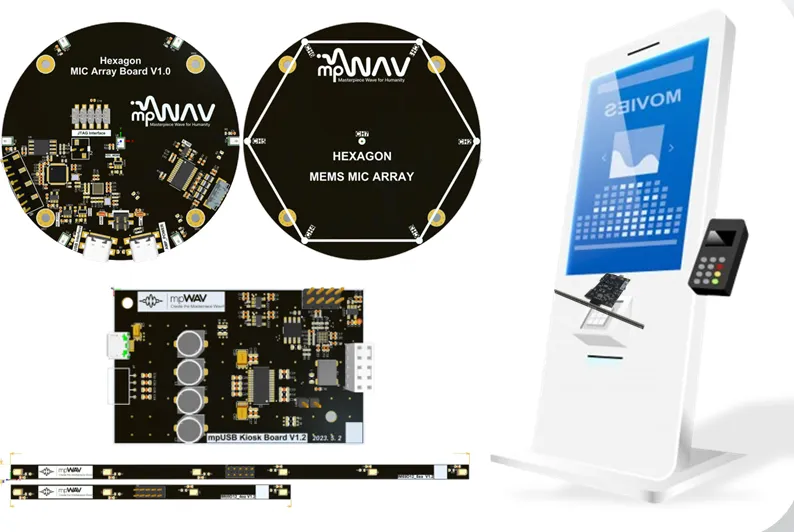
Official material presents design experience with a linear kiosk array and the hexagonal array built for the CES demo.

A good fit when

  • You need to capture far-field user speech
  • You need mpBeamforming or mpLocalization
  • You need to handle the product's speaker echo
  • You want to validate software and hardware together
See the mic array module

DSP·FPGA·AP porting

Real-time execution on your compute platform

We optimize the validated technology for your DSP, FPGA, or AP — multi-channel audio input, memory, compute, and latency.

A good fit when

  • You are moving a PC PoC into the real product
  • You need real-time multi-channel processing
  • You must keep your existing DSP·AP platform
  • You need to connect the voice stack to ASR and product APIs
See DSP·FPGA·AP porting

Licensing·co-development

Technology collaboration around your data and goals

mpWAV's preprocessing, interaction analysis, recognition, conversational AI, or industrial acoustic analysis — licensed or co-developed for your product.

A good fit when

  • You are applying the technology to a product line long-term
  • You need optimization for specific industry data
  • You are developing hardware and software together
  • You need custom analysis such as factory anomaly detection
Discuss licensing·co-development

Semiconductor IP·SoC

Dedicated structures for volume and miniaturization

Building on FPGA·DSP implementation experience, we review semiconductor IP or dedicated SoC collaboration that accounts for the power, size, and cost of volume products.

Official material presents voice interface chips for vehicles, consumer devices, and defense, plus semiconductor IP partnership and dedicated SoC expansion as business directions.

A good fit when

  • You need cost and power optimization for volume production
  • You need a dedicated chip structure for miniaturization
  • You are a semiconductor company exploring IP collaboration
Discuss SoC·semiconductor partnership
Image [P3]
Six portfolio cards (delivery form · technologies · stage · typical products)

Software·SDK | Edge AI | Mic-Array Module | DSP·FPGA·AP Porting | License·Co-Dev | Semiconductor IP·SoC

Software and SDK

Select the voice module that matches your product's problem

The software portfolio spans three areas: improving voice input, analyzing voice interaction, and recognition with dialogue.

Apply a single technology, or combine several into one pipeline.

Voice Enhancement

Improving voice input

mpNC

Reduces ambient noise from a single microphone input.

Fits earbuds and small smart devices that cannot add microphones.

mpAEC

Reduces echo from the device's speaker re-entering the microphone.

mpBeamforming

Uses multiple microphones to reduce ambient noise and strengthen the target voice.

mpAB

Integrates mpAEC and mpBeamforming to handle echo and noise together.

Voice Interaction Intelligence

Wake-up, localization, and speaker analysis

mpWWD

Detects the wake word and activates the product's listening state.

mpS

Prepares multi-party or overlapping voice input for downstream analysis.

mpLocalization

Estimates speech direction or position from multi-microphone input.

mpDiarization

Separates who spoke when in multi-party audio.

Speech Recognition & Dialogue

Recognition and dialogue understanding

mpASR

On-device end-to-end recognition converting speech to text or commands.

mpLLM

A conversational language model connecting intent, context, and product functions.

Image [P4]
Software portfolio map (3 layers, 10 technologies)

Voice Enhancement: mpNC·mpAEC·mpBeamforming·mpAB

↓ Voice Interaction: mpWWD·mpS·mpLocalization·mpDiarization

↓ Recognition & Dialogue: mpASR·mpLLM → Product Function

Modular or Integrated

Pick only what you need — or integrate the whole stack

Front end for your existing ASR

Microphone → mpNC / mpAEC / mpBeamforming / mpAB → Existing ASR

Improves the input signal while keeping your recognition engine.

Robot voice interface

mpWWD → mpLocalization → mpAB → mpASR → mpLLM → Robot Command

Connects wake-up, localization, recognition, and dialogue.

Kiosk voice ordering

Mic Array → mpAB → mpASR → mpLLM → Ordering API

Connects store-noise preprocessing, menu recognition, and conversational ordering.

Single-mic smart device

Single Mic → mpNC → mpWWD → mpASR → mpLLM → Device Function

A single-microphone stack for products that can't add mics.

Meetings & voice chat

mpAEC / Beamforming → mpS → mpDiarization → mpASR → mpLLM → Transcript / Summary

Connects multi-party input, speaker separation, transcripts, and summaries.

Image [P5]
Five modular pipeline cards

Existing ASR front end | Robot | Kiosk | Single Mic | Meeting·Voice Chat

On-Device Edge AI

From wake word to recognition and dialogue — inside the product

A product voice interface needs wake-word detection, input enhancement, recognition, and intent understanding connected in sequence.

mpWAV builds this around mpWWD, mpASR, and mpLLM running inside the product.

Wake word

mpWWD

An always-on product detects the predefined wake word and starts recognition.

Input enhancement

mpNC·mpAEC·mpBeamforming·mpAB

Refines the input to match the product's microphone and speaker configuration.

Recognition

mpASR

Converts commands, menu names, and natural speech to text.

Dialogue

mpLLM

Connects context, menu·options·quantity, and product functions.

Typical applications

  • Conversational kiosks
  • Service robots
  • Vehicle voice interfaces
  • Smart home
  • Small smart devices
  • Network-constrained edge products

On-device feasibility depends on model size, precision, memory, CPU·GPU·NPU, and the product's response-time requirements.

Image [P6]
On-device full stack (cycling inside the product, no cloud)

Wake Word → mpWWD → Voice Enhancement → mpASR → mpLLM → Local Product API

Microphone Array Module

From multi-channel capture to localization and preprocessing

Multi-microphone products must connect mic count and layout, channel synchronization, speaker output, and the AEC reference in one hardware structure.

mpWAV has multi-channel audio hardware design experience including the linear kiosk array and the hexagonal array built for CES.

mpBeamforming

Ambient noise reduction using multi-microphone spatial information

mpLocalization

Speech direction or user position estimation

mpAEC

Echo cancellation using the speaker reference

mpAB

Integrated echo and noise processing

mpASR

Converting the refined audio to text and commands

Examples from official material

Linear kiosk array

  • 4- or 6-channel MEMS microphones
  • 16 kHz·16-bit input
  • 2-channel speaker output
  • 48 kHz·16-bit output

CES hexagonal array

  • 6-channel MEMS microphones
  • 2-channel speaker output
  • 2-channel AEC reference loop-back

※ These are design cases from official material and may differ from currently available standard product specifications. Contact us for supply options and specs.

Image [P7]
Real microphone array photos (linear·hexagonal front, kiosk installation, board connection)

Linear array front | Hexagonal array front | Kiosk installation

Six mic positions | AEC reference & processing board

Embedded Processing Platforms

From software to the real product platform

Running validated mpWAV technology on a real product requires porting that accounts for channel count, memory, latency, power, and audio interfaces.

Official material presents real-time FPGA implementation, MCU+DSP structures, and AP·DSP porting experience.

FPGA

Multi-channel real-time processing and architecture validation

Implements the integrated preprocessing — including mpAEC and mpBeamforming — in real time.

DSP

Low-latency processing inside the product

Optimizes compute, memory, and processing time for the product's audio DSP.

MCU + DSP

Product control and algorithm processing, divided

The MCU handles product control and updates while the DSP handles speech processing.

AP

OS and service integration

Connects audio input, ASR, product APIs, and applications in one software structure.

Edge AI Accelerator

mpASR·mpLLM execution review

Reviews model size and execution paths matched to the product's CPU, GPU, or NPU.

Image [P8]
Embedded platform structure (FPGA·DSP·AP·Edge AI → product)

mpWAV Reference Technology → [ FPGA | DSP | AP | Edge AI ] → Robot·Kiosk·Vehicle·Smart Device

Solution Packages

Technology packages composed for your product

Robot Voice Interface Package

From wake-up to dialogue

Mic Array + mpWWD + mpLocalization + mpAB + mpASR + mpLLM + DSP / AP

Problems solved

  • Wake-word detection
  • User direction estimation
  • Motor·fan noise
  • Robot speaker echo
  • Natural-language commands and dialogue

Conversational Kiosk Package

Conversational ordering in store noise

Linear Mic Array + mpAB + mpASR + mpLLM + Ordering API

Problems solved

  • Far-field speech
  • Store noise
  • Prompt echo
  • Menu·option·quantity recognition
  • Follow-up questions and order flow

Smart Device·Earbuds Package

Voice AI for single-mic products

Single Mic + mpNC + mpWWD + mpASR + mpLLM

Problems solved

  • Structures that can't add mics
  • Limited size and compute
  • Everyday ambient noise
  • Wake word and voice commands

Meeting Intelligence Package

Multi-party records and speaker separation

mpAEC / Beamforming + mpS + mpDiarization + mpASR + mpLLM

Problems solved

  • Multi-party or overlapping speech
  • Speaker separation
  • Speaker echo
  • Meeting minutes
  • Summaries and Q&A

Automotive Voice Package

Natural-language vehicle interfaces in driving noise

Cabin Mic Array + mpWWD + mpLocalization + mpAB + mpASR + mpLLM + DSP / AP / SoC

Problems solved

  • Car audio echo
  • Road·wind noise
  • Per-seat speech
  • Natural-language vehicle commands

Industrial Acoustic Package

Factory anomaly detection

Acoustic Input + Noise-Robust Processing + Anomaly Detection + Edge Integration + License / Co-Development

Image [P9]
Six solution package cards (technology icon pipelines)

Robot | Kiosk | Smart Device | Meeting | Automotive | Industrial

Choose by Development Stage

The right product form depends on your development stage

StageGoalRecommended product·platform
PlanningFeasibility reviewConsultation·architecture design
Data collectionAnalyzing the current problemSoftware Evaluation·USB Audio
PoCBefore/after validationSDK·AI Model·Evaluation Board
PrototypeVerifying real product behaviorMic Array·FPGA·AP Integration
IntegrationRunning on the target platformDSP·FPGA·AP Porting
Pre-productionCost·power·update reviewModule·License
ScaleMiniaturization and cost optimizationSemiconductor IP·Dedicated SoC

Early on, a software PoC identifies the technology you need; module and porting scope are best decided after hardware and the target platform are fixed.

Image [P10]
Stage selection flowchart

Real data? → Software PoC | Mic structure fixed? → Mic/HW Evaluation

Target processor? → DSP·FPGA·AP Porting | On-device AI? → mpWWD·mpASR·mpLLM optimization

Volume production? → Module/IP/SoC Review

Licensing and Co-Development

Technology scoped to your product and data

One software package cannot fit every product.

When your microphones, speakers, compute platform, environment, and service goals are unique, mpWAV technology can be licensed or co-developed for your product.

Algorithm licensing

mpNC, mpAEC, mpBeamforming, mpAB, and acoustic analysis

AI model application

mpWWD, mpASR, and mpLLM optimized per product and domain

Interaction technology

mpS, mpLocalization, and mpDiarization connected to your systems

Hardware co-development

Microphone arrays, AEC reference, and processing boards integrated

Industry co-development

Systems built for robots, kiosks, vehicles, meetings, and factories

Follow-on expansion

Technology proven in the first product extended to other platforms and lines

Image [P11]
Co-development process (product+data → selection → joint PoC → optimization → integration → expansion)

Customer Product + Real-World Data → Technology Selection → Joint PoC

→ Product-Specific Optimization → Platform Integration → License/Production/Expansion

Semiconductor IP and SoC

Extending the voice stack into dedicated silicon

For vehicles, smart devices, and volume products, size, power, and cost matter as much as processing performance.

Building on software algorithms, real-time FPGA implementation, and multi-channel hardware experience, mpWAV reviews voice interface IP·SoC collaboration with semiconductor companies and volume customers.

Technology blocks under review

  • mpAEC IP
  • mpBeamforming IP
  • mpAB integrated block
  • mpNC lightweight enhancement
  • mpWWD wake-word detection
  • Multi-channel Audio I/O
  • On-device mpASR
  • Per-product AI acceleration

Fields under review

  • Vehicles·mobility
  • Smart home·appliances
  • Robots·kiosks
  • Consumer smart devices
  • Defense·special environments

Official material presents voice interface chips and a dedicated SoC as business models and an expansion roadmap. This is currently a co-development and partnership area rather than an off-the-shelf standard chip; specifications and schedules are settled through consultation.

Image [P12]
Semiconductor roadmap (SW → FPGA → module → IP → SoC → production)

Software Algorithm → FPGA Prototype → Product Module → Semiconductor IP → Dedicated SoC → Mass Production

Targets: Performance · Latency · Power · Size · Cost

Technology to Product Map

Technology and delivery forms matched to each application

ApplicationKey technologiesRecommended product·platform
RobotsmpWWD·Localization·mpAB·mpASR·mpLLMMic Array·SDK·AP·DSP·FPGA
KiosksmpAB·mpASR·mpLLMLinear Mic Array·Edge AI·AP
VehiclesmpWWD·Localization·mpAEC·Beamforming·mpASRDSP·AP·FPGA·SoC
Smart devices·earbudsmpNC·mpWWD·mpASR·mpLLMSoftware·Edge AI·AP
Meetings·voice chatmpS·Diarization·mpAEC·mpASR·mpLLMSoftware·PC·Server·Edge
Factory anomaly detectionAcoustic Processing·Anomaly DetectionEdge System·License
Defense·special environmentsmpAB·mpWWD·mpASRFPGA·DSP·SoC
Hearing assistancempNC·Speech EnhancementMobile·ClearSense

This table is a general guide. Real combinations are decided from your product's data and target platform.

Image [P13]
Technology·product·industry matrix (x: delivery forms · y: applications)

Software | Edge AI | Mic Array | DSP/FPGA/AP | License | SoC × 8 application fields

Product Implementation Experience

Beyond validation — connected to products and sites

Robots

ASR preprocessing validated for home, showroom, and care robots

Kiosks

Multi-channel arrays and ASR preprocessing modules deployed

Mobility

Voice interface PoCs in real noise environments

Factory anomaly detection

Motor anomaly analysis validated amid production noise

Hearing assistance

Mobile and earphone voice enhancement via ClearSense Audio

Embedded implementation

Real-time FPGA, MCU+DSP structures, and AP·DSP porting

Image [P14]
Implementation photos (robot·kiosk·vehicle·factory·ClearSense·boards)

Robot interface test | Kiosk linear array | In-vehicle data

Factory motor measurement | ClearSense app | FPGA·DSP boards

From Requirement to Product

Select the technology, then shape it to run in your product

  1. 1

    Confirm requirements

    Product type, users, voice features, and current problems.

  2. 2

    Analyze mic·speaker structure

    Microphone count, speaker output, user distance, and dominant noise.

  3. 3

    Evaluate data

    Single/multi-channel raw audio, the AEC reference, and existing results.

  4. 4

    Compose the stack

    Select what you need from the full mpWAV portfolio.

  5. 5

    Software PoC

    Validate processing results and product features in a reference environment.

  6. 6

    Decide the product form

    SDK, Edge AI, mic array module, porting, or licensing.

  7. 7

    Integrate the platform

    Apply to DSP, FPGA, AP, or an edge AI environment.

  8. 8

    Connect product APIs

    Deliver results to robot control, ordering, vehicle functions, minutes, or alerts.

  9. 9

    Field verification

    Verify on the real product, in its real environment.

  10. 10

    Production & expansion

    Modules, licensing, follow-on products, and dedicated SoC structures.

Image [P15]
Full product timeline (requirements→analysis→data→stack→PoC→form→integration→API→field→production)

Requirements → Acoustic analysis → Data evaluation → Stack → PoC → Product form → Platform integration → API → Field → Production

Project Information

Share the following and we can review the right configuration

Product

  • Product or service type
  • Application field
  • Primary users
  • Usage locations
  • Development stage
  • Launch schedule
  • Expected volume

Acoustic structure

  • Microphone count
  • Microphone positions
  • Speaker count
  • AEC reference availability
  • User distance
  • Dominant noise
  • Multi-party speech

Required features

  • Single-mic noise reduction
  • Speaker echo cancellation
  • Multi-mic noise reduction
  • Wake-word detection
  • Direction estimation
  • Multi-party processing
  • Speaker separation
  • Speech recognition
  • Natural-language dialogue
  • Anomaly detection

System environment

  • CPU·MCU
  • DSP
  • FPGA
  • AP
  • GPU·NPU
  • Operating system
  • Memory
  • Latency budget

Data

  • Raw audio
  • Per-channel microphone data
  • Speaker reference
  • Ground-truth text
  • Existing ASR results
  • Failure cases
  • Menu·command·domain data

FAQ

Frequently asked questions about mpWAV products & platforms

Voice technology delivered as software·SDK, on-device AI, microphone array modules, DSP·FPGA·AP porting, technology licensing, and semiconductor IP·SoC collaboration.

The exact scope varies by technology and project.

Technologies can be applied as individual modules or connected into one integrated configuration.

Delivery units and licensing are agreed per project.

Yes.

mpNC is built for single-microphone input — earbuds and small smart devices that can't fit an array.

Yes.

mpNC, mpAEC, mpBeamforming, and mpAB apply in front of your existing ASR, improving the input audio.

Typically a linear microphone array, mpAB, mpASR, and mpLLM, integrated with your ordering system API.

mpS and mpDiarization process multi-party audio and separate speaker segments, then connect to mpASR.

It is being developed in the direction of a 1B-class on-device dialogue model.

Feasibility depends on model version, precision, memory, accelerators, and response-time requirements.

Official material presents the linear kiosk array and the CES hexagonal array as design cases.

Supply options, specifications, volumes, and lead times are arranged per project — contact us.

Voice interface chips and the SoC are an expansion direction the company is pursuing.

Today this proceeds as semiconductor IP and co-development collaboration, not an off-the-shelf standard chip.

Start with a software PoC based on your microphone count, speaker structure, required features, target platform, and stage — then choose the right delivery form.

Build the Right Product Stack

Design the voice technology and the delivery form together

Tell us your product type, mic·speaker structure, dominant noise, required features, and target platform — we will review the right mpWAV technology and delivery form.

From single-mic noise control to multi-channel echo and noise processing, wake·location·speaker analysis, on-device ASR and conversational LLM, embedded porting and SoC expansion — matched to your development stage.

Image [P17]
Final CTA product stack (requirements → stack → delivery forms → product → real-world experience)

Voice Requirements → mpWAV Technology Stack

→ Software · Edge AI · Module · Porting · SoC → Customer Product → Real-World Voice Experience

mpWAV develops and licenses voice interface technology that makes speech clear in noisy, real-world environments, built on 25+ years of speech signal processing research.

(주)엠피웨이브·사업자등록번호 859-81-01905·대표 박형민

Teilhard Hall 405, 35 Baekbeom-ro, Mapo-gu, Seoul, Korea

02-705-8916·info@mpwav.com

© 2026 (주)엠피웨이브. All Rights Reserved.