
Real-World Applications

AI voice interfaces built for your product and site

mpWAV provides the full voice interface stack — single-microphone noise control, multi-microphone echo and noise preprocessing, wake-word detection, sound source localization, speaker diarization, on-device speech recognition, and a conversational LLM.

For product environments as different as robots, kiosks, vehicles, smart devices, and meeting systems, we select the required technologies and connect them into one working architecture.

Key applications

Robots · Kiosks · Vehicles & Mobility · Smart Devices & Earbuds · Meetings & Voice Chat · Factory Anomaly Detection · Defense · Hearing Assistance

Image [A1]
Applications hero — eight fields connected to the mpWAV stack (B2C hearing in a distinct color)

Robot · Kiosk · Mobility · Smart Device · Meeting · Factory · Defense · Hearing Support

↓ mpWAV Voice Interface Stack

↓ Listen · Understand · Respond

Technology Matched to the Environment

Different industries need different voice technology

mpWAV analyzes your product's microphone count, speaker output, user position, number of speakers, dominant noise, and service goal to compose the right combination of voice technologies.

Earbuds with one microphone start from mpNC; multi-channel robots from mpAEC, mpBeamforming, and mpLocalization; meetings from mpS and mpDiarization; conversational kiosks from mpASR and mpLLM.

We don't force one generic algorithm onto every product — we design the voice stack around the product's conditions.

Image [A2]
Technology selection by product condition

Single Mic → mpNC | Multi-Channel+Noise → mpBeamforming | Speaker+Mic → mpAEC/mpAB

Wake Word·Direction → mpWWD/mpLocalization | Multiple Speakers → mpS/mpDiarization

Recognition → mpASR | Dialogue·Intent → mpLLM

Application Overview

Pick the product and environment you're solving for

Robots

Multi-channel voice interfaces for products that move and speak

Helps robots detect the user's call, find the direction the voice came from, and recognize commands amid their own speakers and motor noise.

mpWWD · mpLocalization · mpAEC · mpBeamforming · mpAB · mpASR · mpLLM

See robot applications

Kiosks

Voice ordering and on-device dialogue in store noise

Captures the user's voice with a multi-channel array, reduces store noise and prompt echo, then understands order intent and options through recognition and a conversational language model.

mpAB · mpASR · mpLLM · Mic-Array HW

See kiosk applications

Vehicles & mobility

Voice commands amid driving noise and car audio

Reduces car audio echo and road noise, then analyzes the wake word, seat or speech direction, and voice commands.

mpWWD · mpLocalization · mpAEC · mpBeamforming · mpAB · mpASR · mpLLM

See vehicle applications

Smart devices & earbuds

Single-microphone processing for products that can't add mics

For earbuds, wearables, and small smart devices where an array isn't possible, one microphone is enough to reduce the impact of ambient noise.

mpNC · mpWWD · mpASR · mpLLM

See smart device applications

Meetings & voice chat

Separating voices and organizing them by speaker

Prepares multi-party and overlapping speech for downstream processing, tells who spoke when, then connects meetings to transcripts and summaries.

mpS · mpDiarization · mpAEC · mpBeamforming · mpASR · mpLLM

See meeting applications

Factory anomaly detection

Detecting abnormal signs amid complex equipment noise

Analyzes production line noise and implements acoustic analysis that distinguishes normal from abnormal motor and equipment sounds.

Noise-Robust Acoustic Processing · Anomaly Detection · Edge Integration

See factory applications

Defense & special environments

Voice interfaces for severely noisy environments

Voice preprocessing, wake-word detection, on-device recognition, and dedicated hardware structures for strong ambient noise and constrained networks.

mpAEC · mpBeamforming · mpAB · mpWWD · mpASR · HW · SoC

See defense applications

Hearing assistance

Clearer everyday conversation in noise

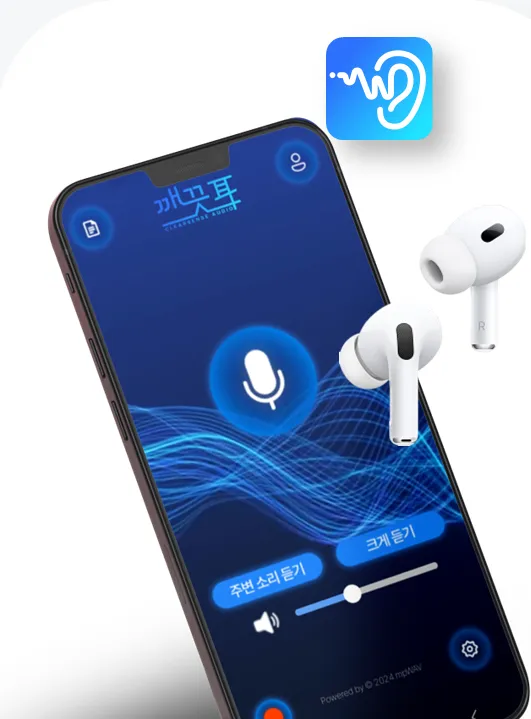
Through ClearSense Audio on a smartphone with ordinary earphones, mpWAV voice enhancement extends to everyday conversation and public hearing welfare.

mpNC · Speech Enhancement · ClearSense Audio

See hearing assistance
Image [A3]
Eight application cards (environment problem · key technology · expected result)

Service robot | Voice-order kiosk | Car cabin | Earbuds·wearables

Meeting room·voice chat | Factory equipment | High-noise environments | ClearSense in use

Robotics

So robots detect the user's call and position — and respond in real noise

Robots run motors and cooling fans while delivering prompts and responses through their own speakers.

Users may call from any direction, not just the front, while nearby conversation and room reflections also enter the microphones.

mpWAV connects wake-word detection, localization, echo cancellation, multi-microphone noise reduction, and recognition-plus-dialogue into the robot's complete voice interface.

mpWWD

Detects the wake word and activates the robot's listening state.

mpLocalization

Estimates the direction or position of the user's voice.

mpAEC

Reduces echo from the robot's own prompts and responses.

mpBeamforming·mpAB

Reduces motor, fan, and nearby-conversation noise, strengthening the target voice.

mpASR

Converts commands into text or robot control commands.

mpLLM

Interprets natural-language commands, questions, and dialogue context.

Example pipeline

Wake Word → mpWWD

→ User Direction → mpLocalization

→ Mic Array + Speaker Reference → mpAB

→ mpASR → mpLLM / Robot Command

Official material presents speech recognition preprocessing validation in home robot, showroom robot, and care robot environments.

Image [A4]
Robot full stack (wake word · direction · noise sources · speaker · mics + pipeline)

Wake word · user direction · motor/fan noise · robot speaker · multi-channel mics

mpWWD → mpLocalization → mpAB → mpASR → mpLLM

Conversational Kiosk

From recognition in store noise to on-device conversational ordering

Accurate recognition alone is not enough for kiosk voice ordering.

Users phrase menus and options in many ways, missing information requires follow-up questions, and the final result must reach the ordering system.

mpWAV connects a linear microphone array, mpAB preprocessing, mpASR recognition, and mpLLM — a 1B-class on-device dialogue model direction — into a conversational ordering pipeline.

Linear mic array

Captures far-field user speech in front of the kiosk on multiple channels.

mpAB

Processes store conversation, background music, and kiosk prompt echo together.

mpASR

Converts menu names, options, quantities, and order utterances into text.

mpLLM

Interprets intent and context, asking follow-up questions for missing information.

Example pipeline

User Speech → Linear Mic Array → mpAB

→ mpASR → mpLLM

→ Menu · Option · Quantity → Ordering API

Example conversation

User“Recommend an iced drink that's not too sweet.”
mpASRConverts the utterance to text
mpLLMIced drink · low sweetness · recommendation intent
KioskRecommends matching menu items and confirms options

Official material presents deployment experience with multi-channel microphone I/O and ASR preprocessing modules for kiosks.

Image [A5]
Kiosk conversational ordering (user·kiosk + processing flow)

Mic Array → mpAB → mpASR → mpLLM → Ordering API

Automotive and Mobility

From wake word to natural-language commands, amid driving noise and car audio

A car cabin combines road noise, wind, HVAC, music, and passenger conversation at once.

The voice interface must recognize the wake word, identify which seat or direction spoke, cancel car audio echo, and then understand commands and natural-language requests.

mpWWD

Detects the automotive wake word.

mpLocalization

Estimates speech direction and seat position.

mpAEC

Reduces echo from car audio and voice prompts.

mpBeamforming·mpAB

Reduces driving noise and passenger conversation.

mpASR

Recognizes navigation, climate, and media commands.

mpLLM

Connects natural-language requests and context to vehicle functions.

Example pipeline

Wake Word → Seat/Direction Detection

→ Cabin Mic Array + Audio Reference → mpAB

→ mpASR → mpLLM / Vehicle Intent

→ Infotainment · Navigation · Control

Official material describes reviewing noise robustness and global expandability in the mobility field.

Image [A6]
In-cabin stack (cabin cross-section — occupants · mics · speakers · noise · direction)

Driver·passengers · cabin mic array · audio speakers · road/wind noise

Direction estimation · mpAEC·Beamforming processing

Smart Devices and Earbuds

AI voice technology for devices that can't add microphones

Earbuds, wearables, and small smart devices often cannot fit a multi-microphone array due to size, layout, and power constraints.

mpNC reduces the impact of ambient noise from a single microphone input, making voice input improvement and a voice interface feasible on single-mic products.

mpNC

Reduces everyday ambient noise from a single microphone input.

mpWWD

Detects the wake word to activate product functions.

mpASR

Recognizes commands and short utterances on-device.

mpLLM

Connects product functions with natural-language requests.

Example pipeline

Single Microphone → mpNC → mpWWD → mpASR → mpLLM → Device Function

Applicable products

  • Wireless earbuds
  • Phone accessories
  • Wearables
  • Portable smart devices
  • Small appliances
  • Voice-controlled IoT devices

Products that cannot fit a multi-channel array are covered by mpNC-based single-microphone processing.

Image [A7]
Single-mic smart device (earbud/wearable cross-section + flow)

Single Mic → mpNC → Wake Word → ASR → Device Action

Meeting and Voice Chat

Separating voices and telling speakers apart where many people talk

Meetings and voice chat can combine multiple talkers, speaker echo, far-field voices, and overlapping conversation.

mpWAV uses mpS to prepare multi-party input for downstream processing, mpDiarization to tell who spoke when, then mpASR and mpLLM to extend into transcripts, summaries, and Q&A.

mpS

Separates and organizes multi-party or overlapping input for downstream processing.

mpDiarization

Separates per-speaker segments and speaker turns.

mpAEC

Reduces echo from speakers or remote participants re-entering the microphone.

mpBeamforming

Reduces far-field voices and ambient noise in the meeting room.

mpASR

Transcribes the meeting audio.

mpLLM

Extends into summaries, key decisions, and Q&A.

Example pipeline

Multiple Speakers + Speaker Echo

→ mpAEC / Beamforming → mpS → mpDiarization

→ mpASR → mpLLM

→ Transcript · Speaker Tag · Summary

Applicable services

  • In-person meetings
  • Video conferencing
  • Voice chat
  • Consultation records
  • Interview analysis
  • Automated minutes
  • Multi-party voice analytics
Image [A8]
Meeting processing timeline (mixed audio → separation → recognition → summary)

Mixed Meeting Audio → mpS → Speaker A/B/C → mpDiarization → mpASR → mpLLM Summary

Industrial Acoustic Anomaly Detection

Analyzing equipment anomalies amid complex production noise

On a production line, many motors and machines run at once, mixing normal and abnormal sounds.

Building on its real-environment noise processing, mpWAV organizes equipment acoustic signals and implements analysis that distinguishes normal from abnormal patterns.

Acoustic preprocessing

Extracts the target equipment's acoustic signature from complex line noise.

Anomaly model

Detects state changes by comparing normal and abnormal data.

Edge processing

Collects and analyzes acoustic data close to the equipment.

License·co-development

Jointly develops data-driven models fit to your equipment and production environment.

Example pipeline

Factory Acoustic Input → Noise-Robust Processing

→ Acoustic Feature Analysis → Normal / Anomaly Classification

→ Inspection · Monitoring · Alert

Applicable areas

  • Motor anomaly sounds
  • Rotating equipment
  • Line acoustic inspection
  • Equipment condition monitoring
  • In-line quality inspection

Official material presents validating motor anomaly detection on a noisy production line without a separate test chamber. Detection accuracy, equipment types, and production status are not specified in public material.

Image [A9]
Factory anomaly analysis (equipment · sensor mics + analysis flow)

Capture → Noise processing → Feature analysis → Normal/Anomaly → Alert

Defense and High-Noise Environments

Voice interface structures for severe noise and constrained connectivity

Defense and special environments can require handling strong ambient noise, limited networks, and embedded compute constraints together.

mpWAV reviews technology collaboration combining multi-channel preprocessing, wake-word detection, on-device recognition, and FPGA·DSP·SoC structures.

mpAEC · mpBeamforming · mpAB

Multi-channel preprocessing amid strong ambient noise.

mpWWD

Wake-word based interface activation.

mpASR

Network-independent on-device speech recognition.

FPGA·DSP·HW · Dedicated SoC

Embedded real-time processing and dedicated chip structures.

Directions

High-noise voice commands · network-independent execution · multi-channel input

Embedded real-time processing · dedicated voice interface chips · per-product co-development

Image [A10]
High-noise embedded structure (generic industrial/special equipment — no weapons or operations imagery)

High-Noise Audio → mpAB → mpWWD → On-Device mpASR → Embedded Control

Hearing Support and Smart Listening

Extending voice technology to everyday conversational clarity

ClearSense Audio is a smart listening solution that helps people hear conversation in ambient noise more clearly, using a smartphone and ordinary earphones.

It extends mpWAV's single-microphone noise control and voice enhancement into B2C products and public hearing welfare.

mpNC·Voice enhancement

Reduces ambient noise in conversation captured by the microphone.

Mobile processing

Supports product structures using a smartphone and ordinary earphones.

User-centered interface

Everyday listening that is easier to access than specialist equipment.

Usage environments

Family conversation · restaurants & cafés · welfare center programs · public hearing welfare · everyday listening

Official material presents ClearSense Audio's welfare center validation and public support program experience.

Image [A11]
ClearSense usage scene (avoid medical device imagery — present as a smart listening product)

Older user + smartphone + ordinary earphones — family/welfare center conversation

Application Technology Matrix

Key technology combinations by application

ApplicationInputInteractionRecognition & DialogueImplementation
RobotsmpAEC·Beamforming·mpABmpWWD·LocalizationmpASR·mpLLMMic Array·DSP·FPGA·AP
KiosksmpABmpWWD as neededmpASR·mpLLMLinear Mic Array·AP·DSP
Vehicles & mobilitympAEC·Beamforming·mpABmpWWD·LocalizationmpASR·mpLLMDSP·AP·SoC
Smart devices & earbudsmpNCmpWWDmpASR·mpLLMEdge·AP·lightweight models
Meetings & voice chatmpAEC·Beamforming·mpSmpDiarizationmpASR·mpLLMPC·Server·Edge
Factory anomaly detectionAcoustic ProcessingAnomaly AnalysisAnalysis models as neededEdge·License
Defense & special environmentsmpAEC·Beamforming·mpABmpWWDmpASRFPGA·DSP·SoC
Hearing assistancempNC·Speech EnhancementMobile·ClearSense

This table is a general guide. Real projects finalize the combination based on product hardware, data, latency, and service goals.

Image [A12]
Matrix visualization (x: all technologies · y: applications, core/optional/none)

NC AEC BF AB WWD S LOC DIA ASR LLM HW × Robot·Kiosk·Mobility·Smart·Meeting…

Find the Right Technology

Pick the voice problem your product faces

Product problemRecommended technology
Only one microphone availablempNC
Echo from the product's own speakermpAEC
Reducing ambient noise with multiple micsmpBeamforming
Echo and noise at the same timempAB
Detecting a wake wordmpWWD
Separating multi-party voice inputmpS
Knowing the speaker's direction or positionmpLocalization
Telling who spoke whenmpDiarization
Converting speech to text or commandsmpASR
Understanding context and intentmpLLM
Multi-channel audio and real-time processingMulti-Channel HW
Image [A13]
Problem-based selection flowchart

Mics? 1 → mpNC / several → mpBeamforming

Speaker present → mpAEC/mpAB | Wake·direction·speakers → mpWWD/Localization/Diarization

Recognition·dialogue → mpASR/mpLLM

Delivery Options

Delivered to match your development stage

Software·SDK

Preprocessing and interaction technology applied in front of your product and ASR.

PoC · validation

Before-and-after comparison with your real product audio and field data.

Mic array module

Multi-channel input, speaker output, and the AEC reference connected in one structure.

DSP·FPGA·AP porting

Runs mpWAV technology on your embedded compute platform.

On-device model optimization

Fits mpASR and mpLLM to the target product's memory and compute budget.

Licensing·co-development

Preprocessing, acoustic analysis, and conversational interfaces co-developed around your product data.

SoC·semiconductor IP

Dedicated voice interface structures for volume production and miniaturization.

Image [A14]
Delivery roadmap (Software → porting → SoC)

Software PoC → Mic/HW Evaluation → DSP·FPGA·AP Porting → Product Integration → License/Co-Dev → Semiconductor IP/SoC

Application Experience

Applicability validated in real products and sites

Robots

ASR preprocessing for home, showroom, and care robots

Kiosks

Multi-channel microphone arrays and ASR preprocessing modules

Mobility

Voice interfaces in real noise, with global expandability reviewed

Factories

Motor anomaly detection validated amid complex production noise

Hearing assistance

ClearSense Audio usability reviewed in welfare center environments

Image [A15]
Experience photos (real products and sites over customer logos)

Robot voice test | Kiosk linear array | In-vehicle data | Factory motor measurement | ClearSense welfare center

From Use Case to Product

We design the right stack starting from your product's usage scenario

  1. 1

    Define the application and features

    Wake-up, commands, dialogue, meeting records, or anomaly detection — we scope what you need.

  2. 2

    Analyze the acoustic structure

    Microphone count, speaker output, user distance, and dominant noise.

  3. 3

    Review real data

    Single/multi-channel raw audio, the AEC reference, and your current ASR results.

  4. 4

    Design the technology combination

    Select from mpNC, mpAEC, mpBeamforming, mpAB, mpWWD, mpS, mpLocalization, mpDiarization, mpASR, and mpLLM.

  5. 5

    PoC & validation

    Evaluate audio quality, detection rates, localization and diarization, recognition, dialogue results, and latency.

  6. 6

    Platform integration

    Apply as software, a mic array, DSP, FPGA, AP, or an edge environment.

  7. 7

    Connect the product API

    Deliver recognition and dialogue results to robot control, ordering, vehicle functions, meeting systems, or alerting.

  8. 8

    Field verification

    Verify performance where the product is actually used, under its real noise.

  9. 9

    Production & expansion

    Review follow-up products, platforms, model optimization, and SoC expansion.

Image [A16]
Process timeline (scenario → analysis → data → stack → PoC → integration → API → field → production)

Scenario → Acoustic analysis → Data → Stack → PoC → Integration → API → Field → Production

FAQ

Frequently asked questions about mpWAV applications

Robots, kiosks, vehicles, smart devices and earbuds, meetings and voice chat, factory acoustic anomaly detection, and hearing assistance.

Defense and special environments are handled as dedicated hardware and co-development areas.

Yes.

mpNC reduces ambient noise from a single microphone input — the technical foundation for earbuds and small smart devices.

mpWWD detects the wake word while mpLocalization uses multi-microphone input to estimate the direction or position of the voice.

mpAB processes store noise and prompt echo, mpASR converts speech to text, and mpLLM interprets menu, options, quantity, and context.

The real ordering API and target hardware still need validation.

mpS and mpDiarization process multi-party input and separate per-speaker segments.

Connected to mpASR, this extends to per-speaker transcripts.

Yes.

mpNC, mpAEC, mpBeamforming, and mpAB apply in front of your existing ASR, improving the input audio.

No.

Depending on microphone count, speakers, user position, number of talkers, and required features, you can select only what you need.

Yes.

Starting from the usage scenario and required voice features, we can review microphone structure, the technology combination, and data collection conditions.

No.

Robots, kiosks, mobility, factories, and hearing assistance have deployment or validation experience in official material. Smart devices, meetings and voice chat, and defense are presented as capabilities and expansion directions.

Design Your Application Stack

Design the voice technology your product needs — starting from the application

Tell us your product type, microphone count, speaker structure, dominant noise, and the features you want to build — we will review the right mpWAV stack.

From single-mic noise control to wake·location·speaker analysis, multi-channel preprocessing, on-device ASR, and a conversational LLM — connected to fit your product environment.

Image [A17]
Final CTA application stack + product icons

Product Environment → Required Voice Technology → PoC → Platform Integration → Real-World Application

Robot · Kiosk · Mobility · Earbuds · Meeting · Factory

mpWAV develops and licenses voice interface technology that makes speech clear in noisy, real-world environments, built on 25+ years of speech signal processing research.

(주)엠피웨이브·사업자등록번호 859-81-01905·대표 박형민

Teilhard Hall 405, 35 Baekbeom-ro, Mapo-gu, Seoul, Korea

02-705-8916·info@mpwav.com

© 2026 (주)엠피웨이브. All Rights Reserved.